
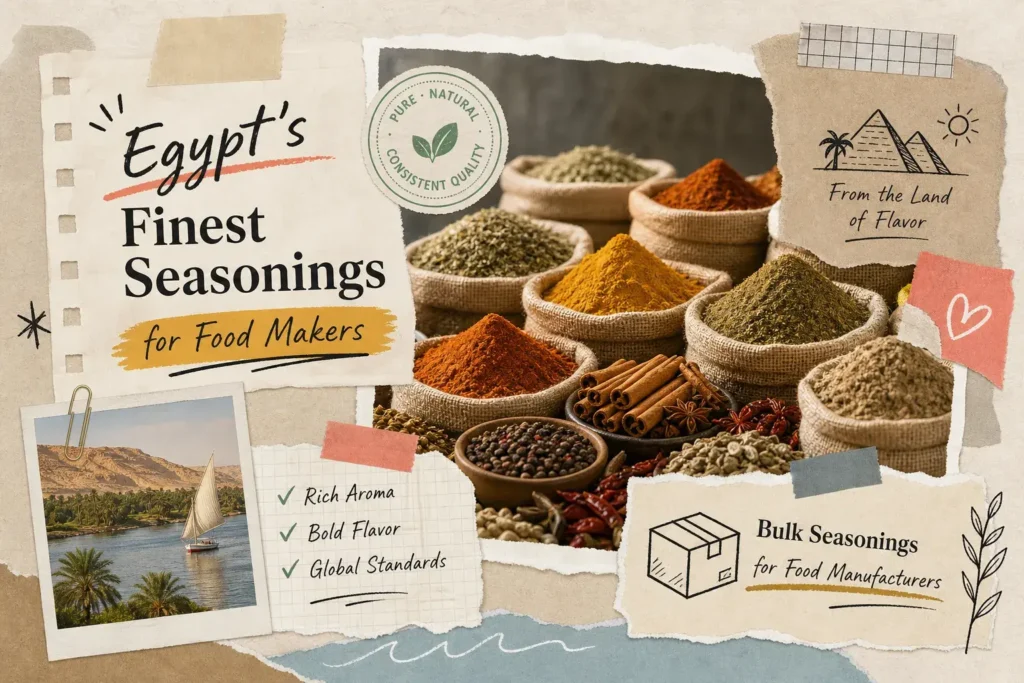
Top Bulk Seasonings from Egypt for Food Manufacturers
Bulk seasonings are dried herbs, spices, and botanical blends purchased at commercial scale, typically starting at full container loads. Food manufacturers, nutraceutical brands, cosmetic formulators, and tea blending operations all depend on this supply stream to keep production lines running. Egypt has a longstanding tradition of herb and spice cultivation, with established production in the Nile Delta delivering reliable, high-volume crops including cumin, coriander, fenugreek, dried mint, and chamomile, all supported by active international trade lanes. At Royal Medical Plants, we are a certified Egyptian manufacturer and exporter shipping these crops to international buyers across Europe, the Middle East, and beyond.
This article covers the Egyptian seasonings that matter most for industrial procurement, what to verify before your first order, and how to manage inventory once a bulk shipment lands at your facility.
Key takeaways
- Egyptian origin advantages: Cumin, coriander, fenugreek, and dried mint are Egypt’s dominant export spices, valued for flavor depth, high essential-oil content, and established global trade infrastructure.
- Certification baseline:Confirm FSSC 22000 or ISO 22000, HACCP documentation, and lot-specific Certificates of Analysis before committing to any supplier.
- MOQ planning:Practical commercial minimums start at 500 kg for air freight and 1 MT for sea freight consolidation.
- Lead time buffer:Build at least an 8-week procurement window for your first international bulk order.
- Supplier qualification:Prioritize manufacturer-exporters who control their own processing and can supply full lot-level documentation with every shipment.
What “bulk seasonings” actually mean for industrial buyers
Bulk herbs and spices in a B2B context are an ingredient category, not a consumer product. A retail spice jar is sold by unit; wholesale seasonings are sold by weight, typically unbranded, minimally packaged, and destined for a manufacturing line, a blending operation, or a supplement formulation. The distinction that separates bulk purchasing from retail purchasing goes beyond volume. It also encompasses the buyer’s intended use, their documentation requirements, and the quality standards that govern their procurement decisions.
Four buyer categories drive the majority of commercial volume in this space. Food manufacturers use single-ground spices and bulk seasoning blends as recipe inputs for sauces, soups, snacks, and ready meals. Nutraceutical companies source medicinal plants and seeds with documented active compound profiles. Cosmetic formulators require botanicals with standardized moisture levels and low microbial counts. Tea and beverage brands need whole or cut-and-sifted herbs with consistent aroma and visual appearance. Each category has different quality triggers, and a supplier who understands all four is worth considerably more than one who serves only a single buyer type.
What to verify before placing a large spice order
Not every bulk spice supplier is equipped for international trade. Before committing to any supplier, confirm they hold certifications aligned with your destination market. For U.S. buyers, FDA facility registration is a baseline requirement. For food-safety management systems, ISO 22000 and FSSC 22000 are the most widely recognized standards in the international spice trade; FSSC 22000 is GFSI-recognized and common among export-grade processors. Organic buyers need USDA Organic or EU Organic certification backed by a valid lot-level certificate. Nutraceutical buyers often require GMP compliance. Kosher and Halal certifications are non-negotiable for certain market segments.
Typical pack formats for bulk orders
Request a Certificate of Analysis for each lot, covering moisture content, microbial counts, heavy metals, and pesticide residue results. Ask for an allergen statement and a processing-treatment declaration confirming whether the product was steam-sterilized, irradiated, or untreated. For EU shipments, verify whether the specific product is subject to enhanced controls under EU Regulation 2019/1793, which requires pre-notification and an official certificate for certain listed products. A supplier who hesitates on any of these documents is not export-ready, and no pricing advantage compensates for a detained shipment at the port.
Pack format is worth confirming early in your supplier conversations. Common export formats for wholesale spice distributors include poly-lined kraft bags, food-grade woven sacks, and fiber drums. Your choice affects freight density, warehouse handling, and how easily you can sub-divide inventory on arrival. Ask your supplier which formats they stock for each product, and clarify minimum quantities per format before finalizing your purchase order.
How Royal Medical Plants handles bulk orders from Egypt
Royal Medical Plants operates as a manufacturer-exporter that processes and exports dried herbs, spices, seeds, and medicinal plants. We are a certified manufacturer-exporter, and our certifications align with international import regulations across our key destination markets.
Our product range covers the breadth of Egypt’s key export categories: from cumin and coriander to fenugreek, dried mint, chamomile, and specialty medicinal plants. We serve food manufacturers, nutraceutical companies, cosmetic formulators, and tea brands, each with their own specification requirements. Royal Medical Plants supplies dried herbs, spices, seeds, and medicinal plants to international food manufacturers, nutraceutical companies, cosmetic formulators, and tea brands.
Sample and testing process
For first-time buyers evaluating our bulk seasonings, reaching out early gives you the most flexibility. Contact our team to discuss your product needs, volume targets, and any certification requirements specific to your market. Royal Medical Plants provides lot-level documentation for its exported dried herbs, spices, seeds, and medicinal plants.
Where can I buy spices in bulk directly from an Egyptian manufacturer?
Working directly with a certified manufacturer-exporter, rather than a trading intermediary, gives you better traceability, cleaner documentation, and more direct control over specifications. Royal Medical Plants is a certified Egyptian manufacturer and exporter. Reach out to our team to request product information or discuss your requirements.
Sourcing bulk seasonings from Egypt starts with the right partner
Bulk seasonings from Egypt offer a genuine combination of origin quality, competitive pricing, and supply-chain transparency, provided the buyer does the upfront work on certifications, documentation, and supplier qualification. Egyptian crops like cumin, coriander, fenugreek, and dried mint carry real technical advantages: high essential-oil content, established international trade lanes, and a manufacturing sector increasingly aligned with U.S. and EU food-safety expectations.
The key is working with a supplier who controls their own processing and can match packaging and volume formats to your actual production needs.
Reach out to our team to request a product catalog, a sample from an active production lot, or a custom quote for your next bulk seasonings shipment. The earlier you start the conversation, the more flexibility you have in your procurement window.